
Ballistic Transport in Copper Films: Implications for Electronics
- June 11, 2026
- Posted by: Alex Reed
- Category: Related News
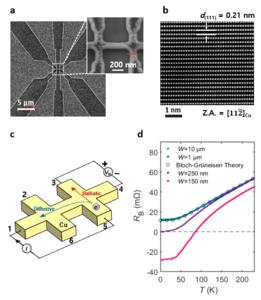
In a significant breakthrough for electronics, researchers have discovered a way for electrons to travel without scattering in copper, a common metal used in many devices. This finding could mean faster electronics with lower power consumption for everyday consumers.
What is Ballistic Transport?
Ballistic transport is a rare phenomenon that allows electrons to move in straight lines without bouncing off other particles. Until now, this has primarily been observed in materials like graphene and specialized nanostructures. In conventional metals like copper, electrons usually scatter frequently, making ballistic transport almost impossible. The recent research from a joint team of universities challenges that belief, as they found that this behavior can actually occur in copper at dimensions relevant to the semiconductor industry.
The team, consisting of experts from POSTECH, Pusan National University, and Mississippi State University, established that in layers of copper that are only 80 nanometers thick and 150 nanometers wide, electrons can travel ballistically. These dimensions are similar to what is currently used in semiconductor wiring, suggesting that the electronics industry could see significant advancements driven by this discovery.
How the Research Was Conducted
To achieve this, the researchers created single-crystalline copper thin films using a technique called Atomic Sputtering Epitaxy. This method produces films with very low surface roughness, minimizing electron scattering. Unlike traditional copper, where electrons get scattered, the new thin films allowed for a direct path for electrons.
The experiments were carried out at very low temperatures, which helped confirm the unique transport properties. Notably, the study identified a strange signal, known as negative bend resistance, that occurs during nonlocal voltage measurements, providing further proof of the ballistic transport.
The Impact on Electronic Devices
The significance of this research lies in the fact that the measurements were taken at a practical interconnect width of 150 nm. This finding could help overcome a major hurdle in electronics: as circuit components shrink, their resistance tends to increase sharply, leading to delays and increased heat. The realization of ballistic transport in copper could pave the way for high-speed, low-power circuits, which is critical for the next generation of semiconductor technologies.
As Professor Gil-Ho Lee explained, this work demonstrates that an ideal transport mechanism can be achieved in a widely-used metal, offering a realistic way to improve efficiency in electronic devices.
What This Means for You
This breakthrough could lead to faster and more energy-efficient electronics, which may lower your energy bills and improve device performance in the future. If you ever need to review a warranty document for your new electronics, AI legalese decoder can help translate it into plain English in seconds.
Need to decode legal language? Try the free AI Legalese Decoder — no registration required.

 ****** just grabbed a