
Is AI Struggling to Improve in Law School Exam Performance?
- June 28, 2026
- Posted by: Alex Reed
- Category: Related News
OpenAI’s advanced AI models are making strides in various fields, including law. But what does it mean for regular people when these models hit a plateau in their performance? Understanding the implications of these developments can shed light on how AI might assist—or fall short—in the legal landscape.
AI Models in Law: Recent Findings
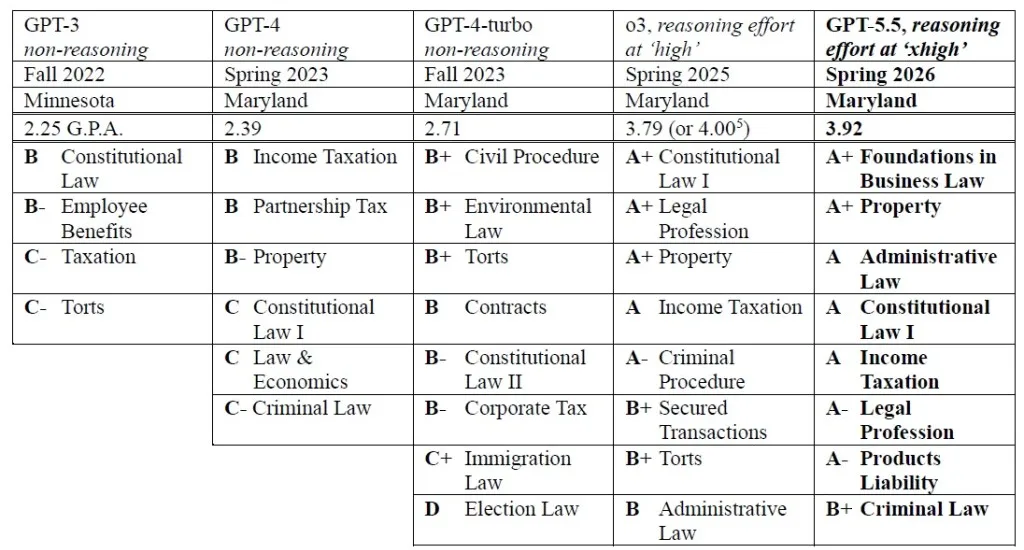
Last spring, a noteworthy experiment featured OpenAI’s reasoning model, known as o3. This model took final exams just like law students, and its performance was impressive, securing grades from A+ to B. Fast forward to this spring, researchers utilized OpenAI’s latest model, GPT-5.5, applying a new “xhigh” reasoning effort parameter to see if it could boost performance. While GPT-5.5 earned two A+s and several As, its overall results suggest a leveling off or even a decline in efficacy compared to o3.
The outcomes of this study are crucial because they indicate a potential stagnation in AI capabilities within legal education. Despite updates and enhancements, these AI models did not significantly outperform their predecessors. For regular individuals and legal professionals, this raises questions about the reliability and utility of AI in complex scenarios, such as preparing legal documents or analyzing case law.
The Implications of Performance Plateauing
The observation that GPT-5.5’s performance may not surpass o3 brings attention to the challenges faced by AI in adapting to evolving legal standards and requirements. Notably, its lack of improvement could hinder its effectiveness in real-world applications. The study points out that one of o3’s lowest grades stemmed from human error, and another was a result of the AI being outdated due to a training cutoff.
This plateau raises questions about the future of AI in law schools and its role in preparing aspiring lawyers. If AI can’t keep up with the challenges of legal studies, its utility in practice—like drafting legal documents or assessing cases—may also be limited. While there is hope that technological advancements might boost future AI performance, current findings suggest caution in relying solely on these tools.
Future Directions for AI in legal Education
Researchers intend to continue experiments with AI and law school exams in upcoming semesters. The aim is to gather more data to better understand AI’s capabilities and limitations. This ongoing research may lead to revisions in the way AI is integrated into legal education, potentially focusing on areas where it can be most effective.
As legal education adapts, the ability to analyze and critique AI’s performance becomes increasingly important. Future endeavors will likely explore how students and educators can work alongside AI to enhance understanding while ensuring that human oversight remains a critical component in legal practice.
What this means for you
For individuals, the evolving relationship between AI and law can influence various aspects of life, from understanding contracts to navigating legal processes. If you ever need to review employment contracts, legal-document-to-plain-english-translator/”>AI legalese decoder can translate it into plain English in seconds. As AI technology progresses, being informed will help you make more confident choices in your dealings with legal documents.
Need to decode legal language? Try the free AI Legalese Decoder — no registration required.
Source: https://taxprofblog.aals.org/2026/06/28/is-ai-law-school-exam-performance-plateauing/

 ****** just grabbed a