
Gold Prices Plummet 3.25% to $4,120 Amid Rising Inflation Data
- June 11, 2026
- Posted by: Alex Reed
- Category: Related News
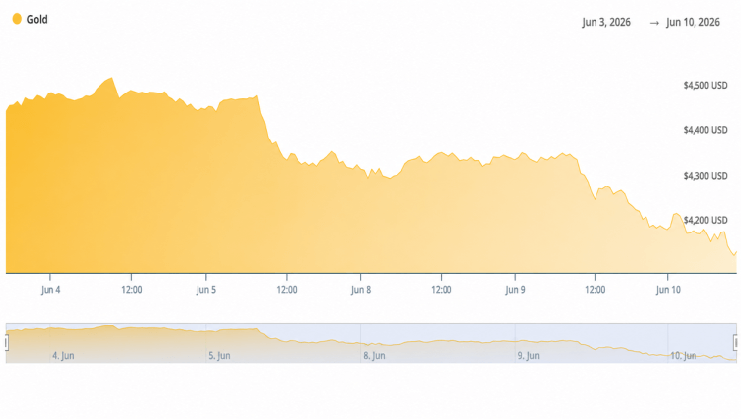
Gold and silver saw significant drops recently, sparking concerns for many who invest in these precious metals. The price of gold fell dramatically, which could impact anyone considering investment in physical assets. Understanding what drives these changes can help you make informed decisions about your finances.
Gold’s Significant Drop
Gold prices declined sharply by $138.60, landing at approximately $4,120 per ounce as of June 10. This drop marked a continuous slide over three days, during which gold lost nearly $210 per ounce. Silver prices also fell to around $64.79. The downward trend followed a report from the Bureau of Labor Statistics confirming an annual rise in the Consumer Price Index (CPI) of 4.2% for May.
At the same time, reports about job growth and inflation have shifted market expectations. Following the May job report, which showed the creation of 172,000 jobs — much higher than expected — traders began to anticipate possible Federal Reserve interest rate hikes in December. Higher interest rates and a firm U.S. dollar typically reduce the attractiveness of non-yielding assets like gold and silver.
During the same period, the ten-year Treasury yield climbed, signaling higher borrowing costs. A stronger dollar also impacts gold prices, making it less appealing for international buyers.
Geopolitical Tensions and Market Reactions
Normally, geopolitical tensions, such as escalating conflicts in the Middle East, drive investors toward gold as a safe haven. However, this time, news about U.S. involvement in conflicts near the Strait of Hormuz coincided with rising oil prices, which fed directly into inflation. Instead of securing assets in gold, traders reacted differently due to the interplay of inflation and higher energy costs.
Despite tensions between Israel and Iran, which historically would push gold prices up, the recent conflicts led to market behavior contrary to expectations. Oil prices soared above $94 per barrel, further complicating the market response. This situation indicates that current inflation and rising yields overshadow the typical market reaction to geopolitical instability.
Historical Trends in Gold Prices
Historical patterns show that gold’s performance during previous conflicts in the Middle East has not always been bullish. For instance, during the 1990 Gulf War, gold prices initially rose before quickly reversing once the conflict was resolved. Similar trends occurred during the 2003 Iraq invasion and after the 2020 Soleimani strike.
The only exception was in 1979 during the Iranian Revolution, when both inflation and dollar weakness caused gold prices to recover significantly. However, today’s economic indicators align more closely with the pre-war scenarios seen in 1990 and 2003 than with the 1979 uprising. Consequently, gold is failing to perform as expected amid current geopolitical tensions.
What Traders Are Keeping an Eye On
Upcoming economic indicators could prove critical in shaping market behavior. The release of the May Producer Price Index (PPI) on June 11 is highly anticipated. Depending on how this report and any new developments in the Iran-Israel conflict unfold, the gold market could either stabilize or face further declines.
If a ceasefire is achieved or if PPI prints lower than expected, we could see a relief rally. Conversely, ongoing inflation or escalated conflicts may drive prices down even further.
What this means for you
Understanding these market fluctuations can aid you in making savvy financial decisions, especially if you’re considering investments in precious metals like gold and silver. If you ever need to review investment contracts or agreements, legal-document-to-plain-english-translator/”>AI legalese decoder can translate it into plain English in seconds.
Need to decode legal language? Try the free AI Legalese Decoder — no registration required.

 ****** just grabbed a