
Sweat Bees Change Color in Humid Weather: What This Means
- April 22, 2026
- Posted by: Alex Reed
- Category: Related News
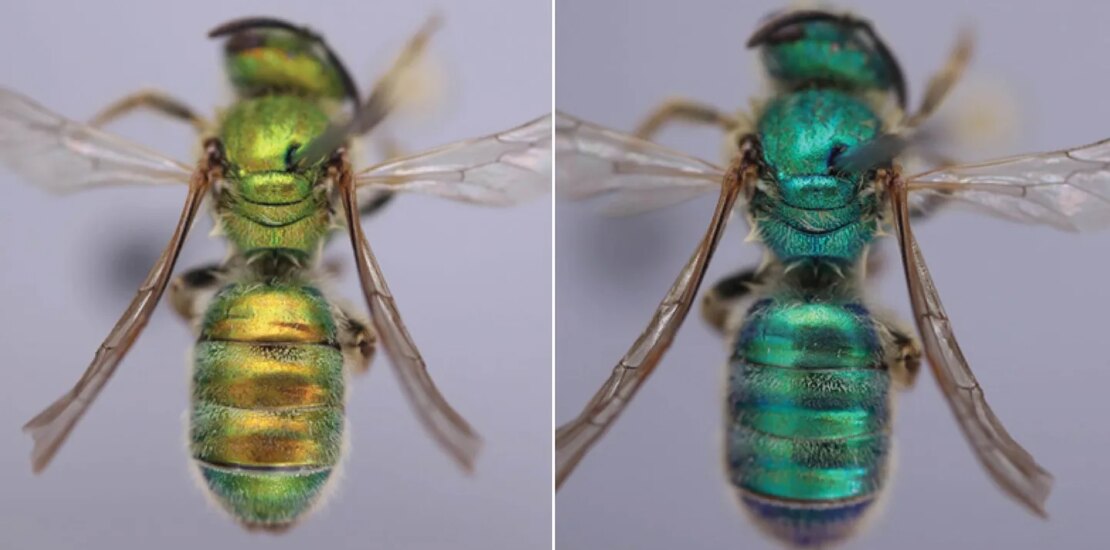
When you step outside and feel the humidity rise, you probably won’t think about how it might affect the local bee population. Yet, scientists have found that moisture levels in the air can dramatically change the color of certain bees. This could have implications for our understanding of these important pollinators and their behaviors.
The Color-Changing Bees
Recent research has revealed that some sweat bees, specifically Agapostemon subtilior, can shift their color based on humidity. In low humidity, these bees exhibit a vibrant blue-green. However, as the air becomes more saturated with moisture, their hue transforms into a coppery green. This discovery was published in a study where researchers experimented with both museum specimens and photos taken by citizen scientists.
The intriguing aspect of this study is that it highlights a much larger potential phenomenon occurring among various insects. Many bees possess a unique metallic sheen on their exoskeletons. This shininess contributes to their vibrant colors, which can be manipulated by humidity levels. When scientists placed bee specimens in high-humidity conditions, they noticed the change in color—a compelling indicator that environmental factors significantly impact insect appearance.
How Scientists Conducted the Study
The research began when an undergraduate student, Jorge De La Cruz, observed this color shift in bee specimens at the University of California, Santa Barbara. Along with his advisor, Madeleine Ostwald, they examined dozens of bee specimens under varying humidity conditions. They took photographs of these bees exposed to high and low humidity for extensive periods.
In addition, they analyzed over 1,000 images of living sweat bees sourced from the citizen science platform iNaturalist, noting the humidity during each photo’s capture. The results were consistent: the bees shifted from blue-green in dry environments to lighter shades of green when humidity increased.
The Science Behind the Color Change
The researchers proposed a hypothesis explaining the phenomenon that the humidity causes the layered structure of the bees’ exoskeletons to expand. This expansion leads to altered light reflection, creating the noticeable shift in color.
In simpler terms, as humidity increases, the space between the layers in the bees’ exoskeletons grows, which can reflect different wavelengths of light. This is why the bees appear reddish under high moisture—longer wavelengths dominate light reflection at elevated humidity levels. Ostwald suggests that high-powered microscopes could further confirm these findings and explore whether similar changes occur in other insects.
Implications for Understanding Insects
Understanding how environment influences color in bees and other insects sheds light on their adaptive behaviors. These color changes may play a significant role in communication, mating, and even camouflage. The findings emphasize the importance of studying organisms in their natural habitats. Colors can shift dramatically when these creatures are removed from their typical environments, leading to potential misinterpretations of their behaviors or interactions.
Since bees are crucial for pollination and ecosystem health, recognizing how external factors like humidity impact them becomes essential for conservation efforts. This understanding can inform strategies to protect bee populations against climate-related stresses.
What This Means for You
This research reveals that something as simple as humidity can affect the color of bees, demonstrating how dynamic these creatures can be. If you ever find yourself reading about the terms in a contract that involves environmental impact or wildlife protection, legal-document-to-plain-english-translator/”>AI legalese decoder can help you translate it into plain English in seconds.
Need to decode legal language? Try the free AI Legalese Decoder — no registration required.
Source: https://www.sciencenews.org/article/humidity-bee-hue-color-change

 ****** just grabbed a