
AIPOCH Introduces MedSkillAudit to Assess Medical AI Skills Before Use
- June 29, 2026
- Posted by: Alex Reed
- Category: Related News
Medical research is evolving quickly, with artificial intelligence (AI) playing a growing role. The launch of MedSkillAudit highlights how vital it is to ensure AI tools are reliable and safe for researchers and, ultimately, for patients.
Introducing MedSkillAudit
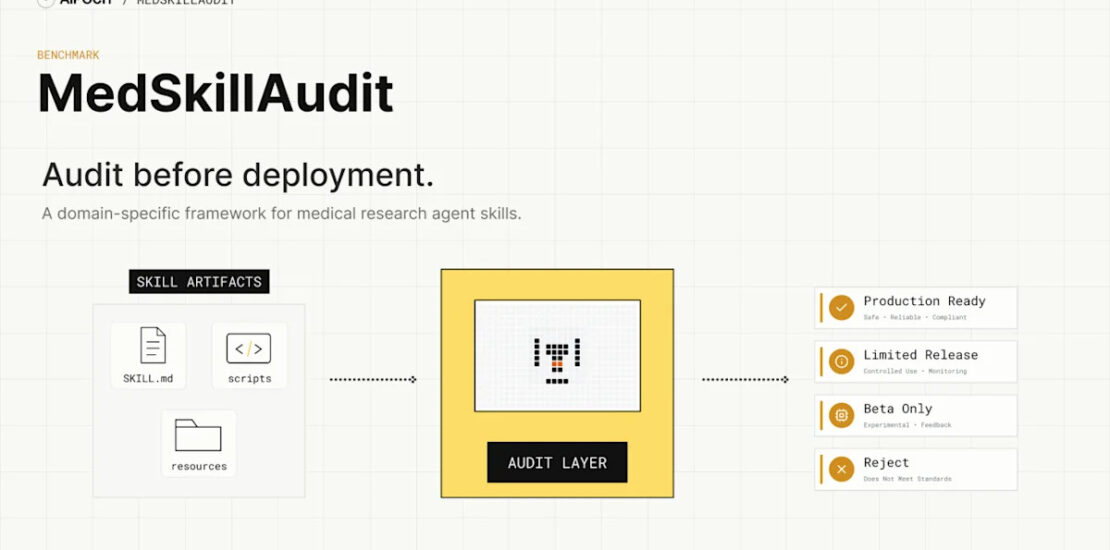
AIPOCH PTE. LTD., in partnership with the Department of Pathology at Zhongshan Hospital, Fudan University, has introduced MedSkillAudit, a new framework focused on evaluating the performance of AI agents before their deployment in medical research. This initiative aims to tackle the shortcomings of existing quality-control methods. Traditional approaches often miss issues like scientific errors or unethical citations. MedSkillAudit is designed to investigate these failures before the AI tools reach researchers, enhancing both safety and integrity in medical research.
The research supporting the framework was initially shared as a preprint on arXiv in April 2026. With AI agents becoming integral in tasks such as literature screening and manuscript drafting, maintaining their reliability is essential for the scientific community.
A Comprehensive Review Process
MedSkillAudit introduces a robust two-layer review process known as the “veto gate.” The first layer assesses technical aspects like operational stability and system security. The second layer focuses on scientific integrity, checking for issues such as fabricated data, improper disclaimers, and logical fallacies. If any area falls short, the AI skill is barred from being used in research.
This careful scrutiny is necessary because many AI agents in medical research are built from different modular skills. Each of these skills must pass through the assessment gates to ensure they meet set standards. This system aims to reduce the risk of flawed research and enhances trust in AI technologies used in healthcare.
Evaluating Performance and Readiness
The MedSkillAudit framework further employs a two-stage evaluation process. The first stage is a static evaluation, which considers the design quality of the AI tool and accounts for 40% of the final score. The second stage is dynamic evaluation, testing how well the AI performs in real-time scenarios, contributing 60% to the overall score. At the end of this assessment, skills are categorized into four readiness levels: “Production Ready,” “Limited Release,” “Beta Only,” or “Rejected.”
A validation study involving 75 AI skills across various medical research categories revealed that over half of the tested skills did not meet basic quality requirements. This outcome underscores the pressing need for rigorous quality control in the development of AI agents used for medical applications.
Aligning with Expert Review
Excitingly, findings from the study showed that MedSkillAudit’s assessments closely matched recommendations from expert reviewers. This consistency suggests that the framework could serve as a reliable tool for validating the efficacy of AI technologies in medical research.
Huimei Wang, CEO of AIPOCH, emphasizes the importance of such frameworks, stating that AI agents are now part of scientific workflows. However, quality-control checkpoints for these agents are still lacking. MedSkillAudit aims to identify and mitigate potential scientific, methodological, and ethical risks associated with AI tools before they enter the research landscape.
What this means for you
The introduction of MedSkillAudit signifies strides toward safer and more reliable medical AI tools. Understanding these developments is crucial for anyone involved in healthcare or research. If you ever need to review contracts or agreements related to medical research, legal-document-to-plain-english-translator/”>AI legalese decoder can help decode the fine print in seconds.
Need to decode legal language? Try the free AI Legalese Decoder — no registration required.

 ****** just grabbed a