
Northern Lights Watch: Enhanced Alert for 25 States Thursday
- June 4, 2026
- Posted by: Alex Reed
- Category: Related News
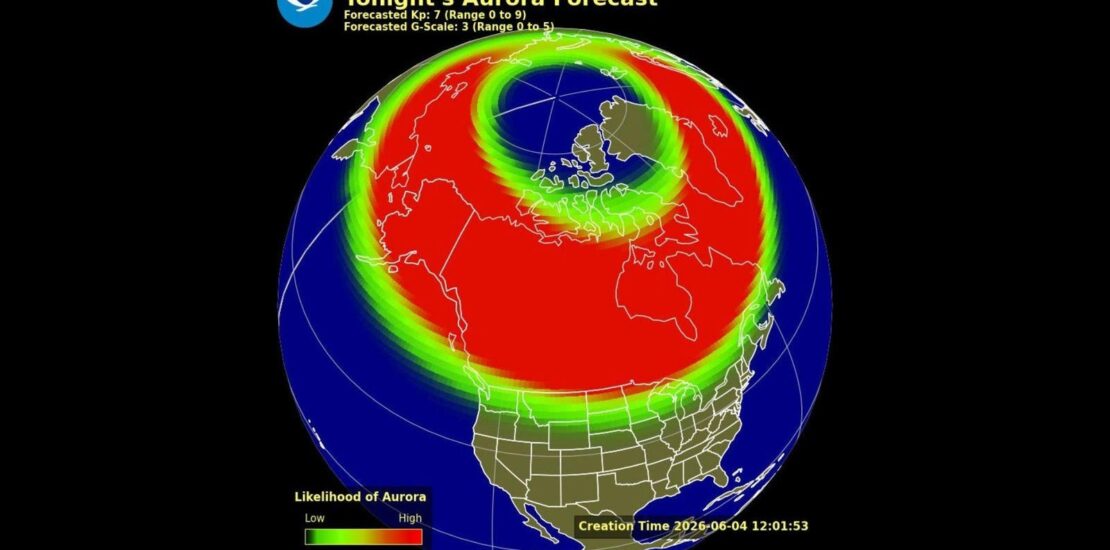
Forecasts indicate that a spectacular display of northern lights might light up the skies over North America. This is important for everyone, as these natural wonders are breathtaking to witness and can even impact technology and power systems on Earth.
The Impact of Solar Activity
The National Oceanic and Atmospheric Administration (NOAA) has upgraded its forecast for the northern lights due to the detection of multiple coronal mass ejections (CMEs) directed toward Earth. These CMEs are immense clouds of superheated gas and magnetic fields ejected by the sun, often following solar flares. NOAA now predicts strong to severe geomagnetic storms starting Thursday, June 4, and continuing into Friday, June 5.
In recent updates, NOAA suggests that the geomagnetic activity could escalate rapidly. Initial forecasts mainly pointed to Friday as the highlight. However, now it appears that significant aurora activity may begin Thursday afternoon, with conditions improving into the night. Residents in several U.S. states are encouraged to look north if the sky is clear once darkness arrives.
What to Expect When Watching the Skies
The latest discussions from NOAA predict geomagnetic storm levels could reach G2 (Moderate) and G3 (Strong) classifications. There’s even a chance of G4 (Severe) conditions, especially during the nighttime peak of the event. It’s important to note that exact timings can be unreliable, as conditions may change suddenly. Peak activity may be forecasted just 30 minutes before it happens.
For those eager to catch a glimpse, it’s best to stay updated using apps specialized in space weather. Real-time alerts will provide the latest information on when and where to view the auroras.
Best Locations for Aurora Viewing
So which states are in the best position to witness this light show? The northern states like Washington, Idaho, and Minnesota are prime spots. If G4 conditions indeed emerge, awe-inspiring views might stretch farther south than usual, potentially reaching parts of mid-latitude states like Ohio and Illinois.
While significant aurora displays are rare in southern areas, earlier storms have made them visible in over 25 states. To keep track of the aurora’s progress, skywatchers should frequently check real-time weather updates from platforms like Space Weather Live.
The Science Behind the Lights
To better understand the aurora’s intensity, enthusiasts utilize the Kp index, which measures geomagnetic storm strength. The most critical factor is the orientation of the solar wind’s magnetic field. When certain conditions arise, individual geomagnetic storms can combine their energy, leading to intensified auroras.
However, users in northern areas face a seasonal challenge: as the June solstice approaches, nights become shorter, and twilight persists much longer. This limits the darkness needed for optimal viewing conditions, even if the geomagnetic conditions are favorable.
What this means for you
Witnessing the northern lights can be a memorable experience. If you plan to go out, make sure to check local weather conditions and know the best times for visibility. Additionally, if you ever need to review weather-related warnings or alerts, AI legalese decoder can help translate them into plain English in seconds.
Need to decode legal language? Try the free AI Legalese Decoder — no registration required.

 ****** just grabbed a