
Graphene Breaks Boundaries: A New Era in Physics Unveiled
- April 15, 2026
- Posted by: Alex Reed
- Category: Related News
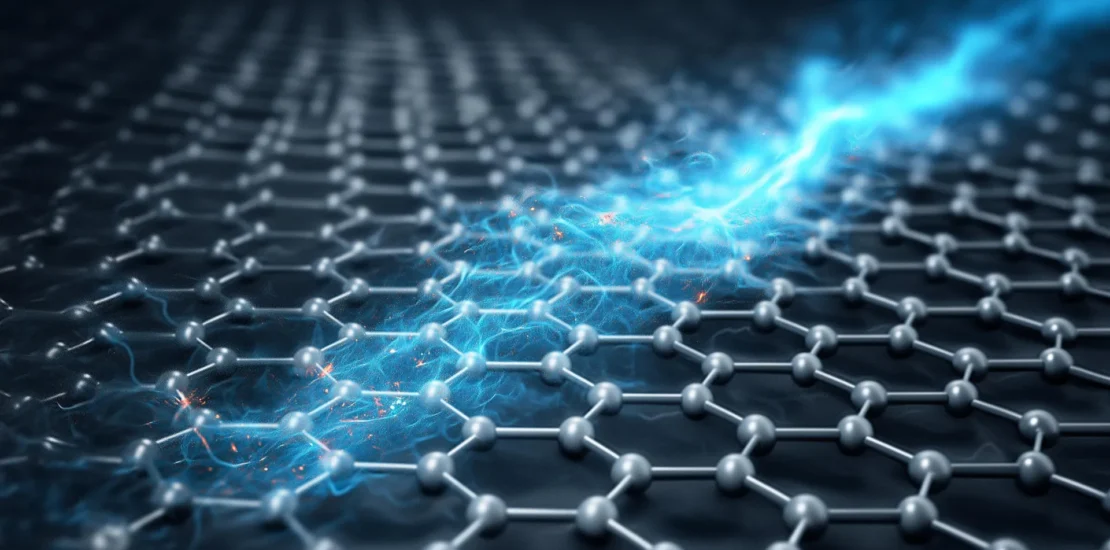
For years, scientists have wondered if electrons can move like a smooth, frictionless fluid. This question isn’t just a curious academic pursuit—it may lead to breakthroughs in technology that affect everyday lives, from smarter devices to advanced sensors.
The Breakthrough in Graphene Research
Researchers at the Indian Institute of Science (IISc), in collaboration with the National Institute of Materials Science in Japan, have made a significant discovery regarding electron behavior in graphene, a single layer of carbon atoms. Their findings, published in Nature Physics, reveal what they term a quantum fluid—a state where electrons move collectively like a fluid rather than as individual particles.
Understanding this new behavior is more than just a scientific achievement. It positions graphene as a new platform for exploring quantum effects, which have been challenging to observe due to imperfections in real materials. According to Arindam Ghosh, a professor at IISc, this discovery highlights that even after 20 years of studying graphene, the material continues to surprise researchers.
Challenging Established Physics Laws
To find this unusual electron behavior, the research team created exceptionally clean graphene samples, meticulously measuring how the material conducts electricity and heat. Surprisingly, they discovered that as electrical conductivity increases, thermal conductivity decreases—an outcome that contradicts the long-standing Wiedemann-Franz law. This law traditionally suggests that heat and electrical conduction should work hand in hand in metals.
The researchers noted deviations from this law by over 200 times at low temperatures, showcasing a striking disconnect between how charge and heat travel through graphene. This significant finding questions some of the fundamental principles of physics and invites further investigation into the nature of electron behavior.
The Concept of the Dirac Fluid
The behavior stems from a special state known as the "Dirac point," where graphene transitions between being a metal and an insulator. At this point, electrons act like a collective fluid, moving in unison much like flowing water but with far less resistance. This new state of matter, termed a Dirac fluid, is a fascinating parallel to the quark-gluon plasma observed in particle accelerators.
Aniket Majumdar, the lead author and a PhD student at IISc, explains that this fluid-like behavior opens the door to exploring various phenomena usually linked to extreme conditions. With low viscosity, this Dirac fluid is one of the closest realizations of a perfect fluid observed in a laboratory, offering scientists a unique avenue for research.
Implications for Future Technologies
The discovery of a Dirac fluid in graphene has vast implications, particularly in quantum technology. Not only does it enhance our understanding of fundamental physics, but it also paves the way for innovative advancements. For example, this material could help develop ultra-sensitive quantum sensors capable of detecting weak electrical signals and faint magnetic fields.
Such technology could transform various industries, including healthcare, electronics, and environmental monitoring. As the scientific community begins to harness the unique properties of graphene, the potential applications may become revolutionary, bridging the gap between complex physics and practical everyday technology.
What this means for you
For regular folks, this discovery may one day lead to more efficient technologies that improve daily life and enhance device performance. If you ever need to review technical documents like product specifications or warranties that could relate to these advancements, legal-document-to-plain-english-translator/”>AI legalese decoder can decode the fine print and make it easier to understand.
Need to decode legal language? Try the free AI Legalese Decoder — no registration required.
Source: https://www.sciencedaily.com/releases/2026/04/260415042152.htm

 ****** just grabbed a