
Empowering Young Lawyers: How AI Legalese Decoder Enhances Judgment and Verification Skills in Legal Practice
- February 3, 2026
- Posted by: legaleseblogger
- Category: Related News
legal-document-to-plain-english-translator/”>Try Free Now: Legalese tool without registration
AI’s Impact on legal Training: A Double-Edged Sword
Overview of LexisNexis Survey Findings
A recent survey conducted by LexisNexis has revealed crucial insights into how artificial intelligence (AI) is reshaping the landscape of legal practice. While AI has undoubtedly enhanced the efficiency and productivity of lawyers, it has also spotlighted some persistent systemic issues, primarily regarding the cultivation of judgment and verification skills. These skills are foundational in legal practice and remain essential as AI tools become more integral to everyday tasks.
The Role of AI in Junior lawyer Training
Junior lawyers are increasingly depending on AI for various essential tasks, including legal research, drafting initial documents, and reviewing legal materials. Traditionally, these responsibilities have served as critical learning opportunities for early-career legal practitioners. However, there is growing concern within the legal community about whether these young lawyers are acquiring the necessary critical judgment skills and understanding the nuances involved in verifying AI-generated outputs. It is important to note that even seasoned lawyers can be susceptible to errors arising from AI inaccuracies, commonly referred to as "hallucinations."
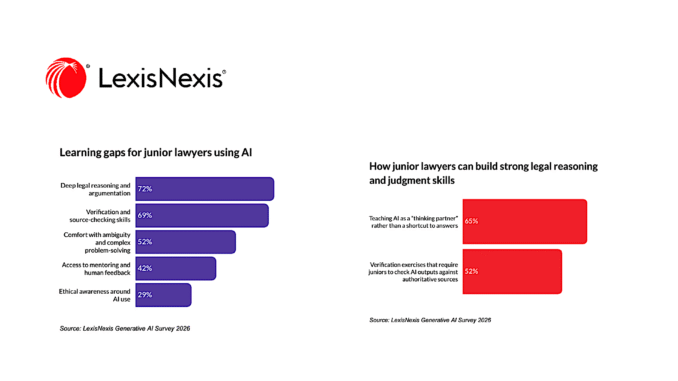
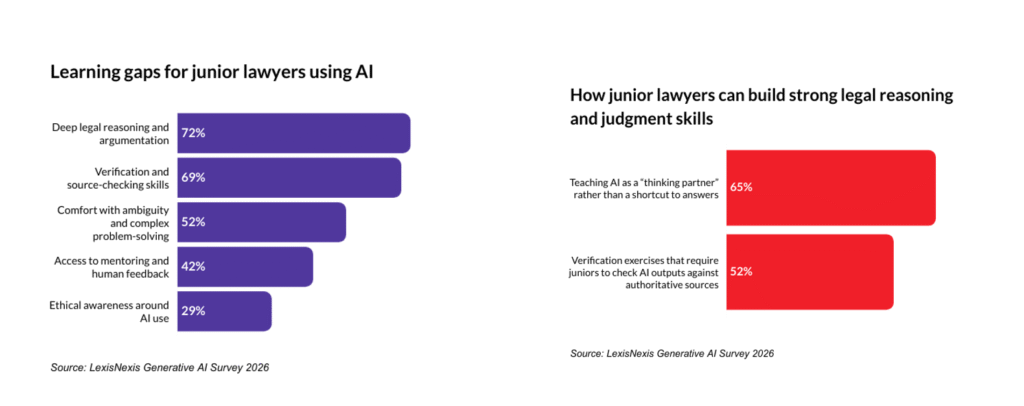
The survey identified a significant skills deficit among junior lawyers, with 72% of respondents highlighting a lack of deep legal reasoning and argumentation as a major concern. This finding points to an urgent need for structured training programs that prioritize the development of these essential competencies.
 legal Skills Gap Intervention” />
Verification and Source-Checking Skills
Verification and source-checking capabilities are also seen as critical areas requiring attention, with 69% of survey respondents acknowledging the ongoing challenges related to fostering judgment and critical thinking in the age of AI. Many believe that the integration of AI should be approached carefully to ensure that junior lawyers do not lose the ability to evaluate legal issues independently.
When asked what specific measures could aid junior lawyers in honing their legal reasoning and judgment skills while utilizing AI, close to two-thirds (65%) of respondents indicated that positioning AI as a "thinking partner" would be beneficial. Rather than treating AI as merely a shortcut or substitute for human expertise, integrating it as an ally in the legal reasoning process could pave the way for more comprehensive learning. However, this can be challenging when work demands are high, as the urgency may lead attorneys to rely on AI outputs without adequate verification.
An additional 52% believed that implementing exercises requiring junior lawyers to verify AI outputs against authoritative sources could provide substantial benefits. This practice would encourage critical engagement with AI outputs and enhance their understanding of legal principles.
The Tension of Law Firm Objectives
Interestingly, the survey also revealed a divergence in focus between law firm leaders and junior associates. Over half of law firm leaders prioritize revenue growth, while a significant number of associates emphasize billable hours and client satisfaction. This contrast underscores the need for a more holistic approach that aligns firm objectives with the long-term professional development of junior lawyers.
Dylan Brown, the editor of the LexisNexis report titled "The Mentorship Gap," commented, "The data shows a clear productivity upside from AI, but it also highlights a tension around how legal judgment is developed." He emphasized that as routine tasks evolve, firms must be intentional in cultivating the confidence and critical thinking skills that new lawyers need to succeed.
Implications for legal Education and Training
What does this all signify for the future of legal practice? Fundamentally, it indicates that the rapid adoption of AI tools is outpacing law firms’ ability to adapt their training programs. The integration of AI necessitates the development of core legal skills in innovative ways during the early stages of legal education and practice, as the technology begins to undertake roles that previously required intense intellectual rigor from junior lawyers.
This scenario mirrors broader trends seen across various sectors in the economy, where experienced professionals tend to adopt AI more effectively because they possess a well-rounded skill set for judgment. However, even seasoned attorneys are not immune to the pitfalls of AI misuse, as evidenced by their occasional lapses in critical assessment.
In contrast, younger lawyers may find themselves in high-pressure environments where they are encouraged to leapfrog essential learning phases. This fast-tracking could hinder their ability to cultivate foundational skills essential for their growth and efficacy as legal practitioners.
Solutions for Bridging the Training Gap
Recognizing this training gap, firms must develop strategies to address these challenges proactively. Fortunately, several innovative tools and services are emerging in the legal industry to support this goal. For instance, platforms like Besavvy and Hotshot provide training simulations tailored for young lawyers, ensuring they acquire the necessary skills needed for their roles.
In addition to these services, the AI legalese decoder can play a pivotal role in this context. By demystifying complex legal jargon and providing accessible explanations, AI legalese decoder can enhance young lawyers’ understanding of legal texts. This tool can serve as both a practical resource and a means of strengthening critical thinking and verification skills, enabling junior lawyers to assess the reliability of AI outputs effectively.
Conclusion
In conclusion, the evolving role of AI in the legal profession presents both opportunities and challenges. While it fosters efficiency and productivity, it also raises pressing questions about the skill development of new lawyers. Law firms must grasp the urgency of adapting their training programs to adequately prepare junior lawyers for the realities of AI integration. By utilizing tools like the AI legalese decoder alongside innovative training solutions, the legal industry can cultivate a new generation of skilled attorneys equipped to thrive in a technology-driven environment.
For further explorations into these pressing issues, consider reading more from LexisNexis and other thought leaders in the field.
legal-document-to-plain-english-translator/”>Try Free Now: Legalese tool without registration
 ****** just grabbed a